

A Deep Dive on The Release Layer System and the Future of Helmet Technology
An interview with CEO Jamie Cook and Head of Research Maria Kaimaki

Earlier this year, the Release Layer System (“RLS”) launched publicly. This ball bearing-based helmet panel release system reduces the torques and forces associated with head injuries by coming apart during a cycling accident when the head makes contact with the ground. In the current sports technology landscape very often focused on analytics and AI, it was exciting to see a truly novel hardware innovation hit the market, especially one that promises safety improvements for such a major global sports and activity in cycling. Having personally been hit by a car while commuting by bike, I’m also selfishly very eager to see products like RLS succeed. (I’ve also crashed myself on a gravel bike descent but that was totally self-induced and we don’t talk about that…)
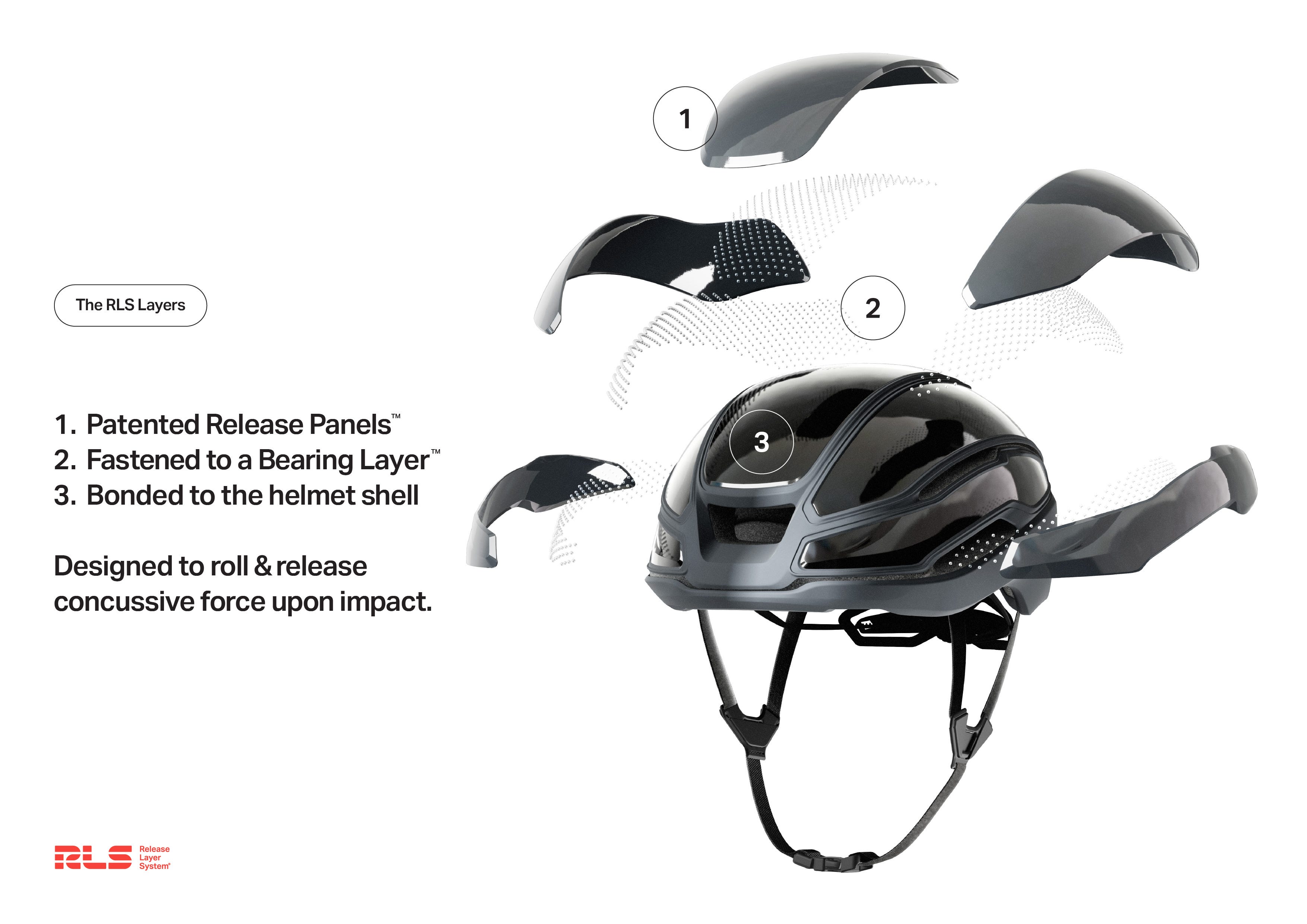
The amount of individual and collective effort and creativity that goes into launching any new company is difficult to overstate, so the fact that the team at RLS managed to launch such a polished product in the midst of rapid growth is a testament to the entire team’s work. Solving difficult product design challenges is extremely fun and rewarding, but the development process can be extremely nonlinear and it’s often difficult to actually productize a new invention. It’s equally difficult to commercialize a new product and to build a company around it — doubly so when you are creating the product and commercializing it simultaneously.
With my own excitement for RLS as a product and admiration for the RLS team, I jumped at the chance to interview some of the brains and brawn behind it: CEO Jamie Cook, and Head of Research Maria Kaimaki. The discussion with Jamie and Maria helped close many gaps in my own knowledge about how bike helmets work, how they are tested, and how the team that developed RLS managed to do it. More importantly, I think their answers reveal their depth of knowledge and passion for these topics, and provide glimpses into the future of not only bike helmet technology, but the likely evolution of helmets in other sports and industries too. I’m excited to watch it all unfold!
I am very thankful for Jamie and Maria’s time, and for Mathilde managing our time-zone-scattered schedules to coordinate the call! This inaugural Geek Locker interview is relatively long, so I’d definitely recommend grabbing a cup of coffee or tea to settle in, or listening through the narration feature if you’re on the move. If you’d like to see more long-form interviews like this in the future, please don’t hesitate to reach out!
Cam: To jump right in, I think the first question that I had was: it seems like your technology is more broadly applicable outside the world of just cycling. Potentially in MotoGP and other motor sports, but then also in ice hockey, potentially American football, and many more. I’m curious, you know, beyond your own familiarity with the sport and its products, what made you focus on cycling as your beachhead for this new technology?
Jamie: So, RLS came from the company HEXR [a 3D-printed bike helmet company]. And HEXR was established because we, at the time, saw 3D printing as a major opportunity to reshape and redefine how energy absorbing structures could be created.
At the time, I was doing a lot of rowing, and used the bike to get around London because it was too expensive to get the tube. So I would spend, I don’t know, two to three hours cycling around London most days. And if you’ve ever cycled around London, you’ll be pretty familiar with just the amount of near misses. And unfortunately, I witnessed some pretty bad accidents that then led me to going to a bike shop and try to understand what elements of protective gear were actually safe and how helmets work. I realized that most helmets really were just the same, and there hadn’t been significant innovation for many decades.
From that interest, I began to research 3D printing structures to replace the energy absorbing foam used in bicycle helmets. Inadvertently, we found that the outer shell [of the helmet] would separate on impact, and while it wasn’t particularly effective, it was a new approach for thinking about how helmets reduce harmful forces, and that started the R&D evolution towards the Release Layer System.
Maria: If I can add something to this, I think an interesting point is also that when you’re creating a new technology, you want to test it in a way that your target audience would understand its potential. And the cycling helmet market is a very good one to start from because of how visible the accidents are, and because of how it’s been a pioneer for changes in safety standards. The way many helmets are tested to date is against a flat surface to measure their linear energy absorption. However, we know that that is not sufficient, rotation in the brain is what is responsible for injuries such as concussions.
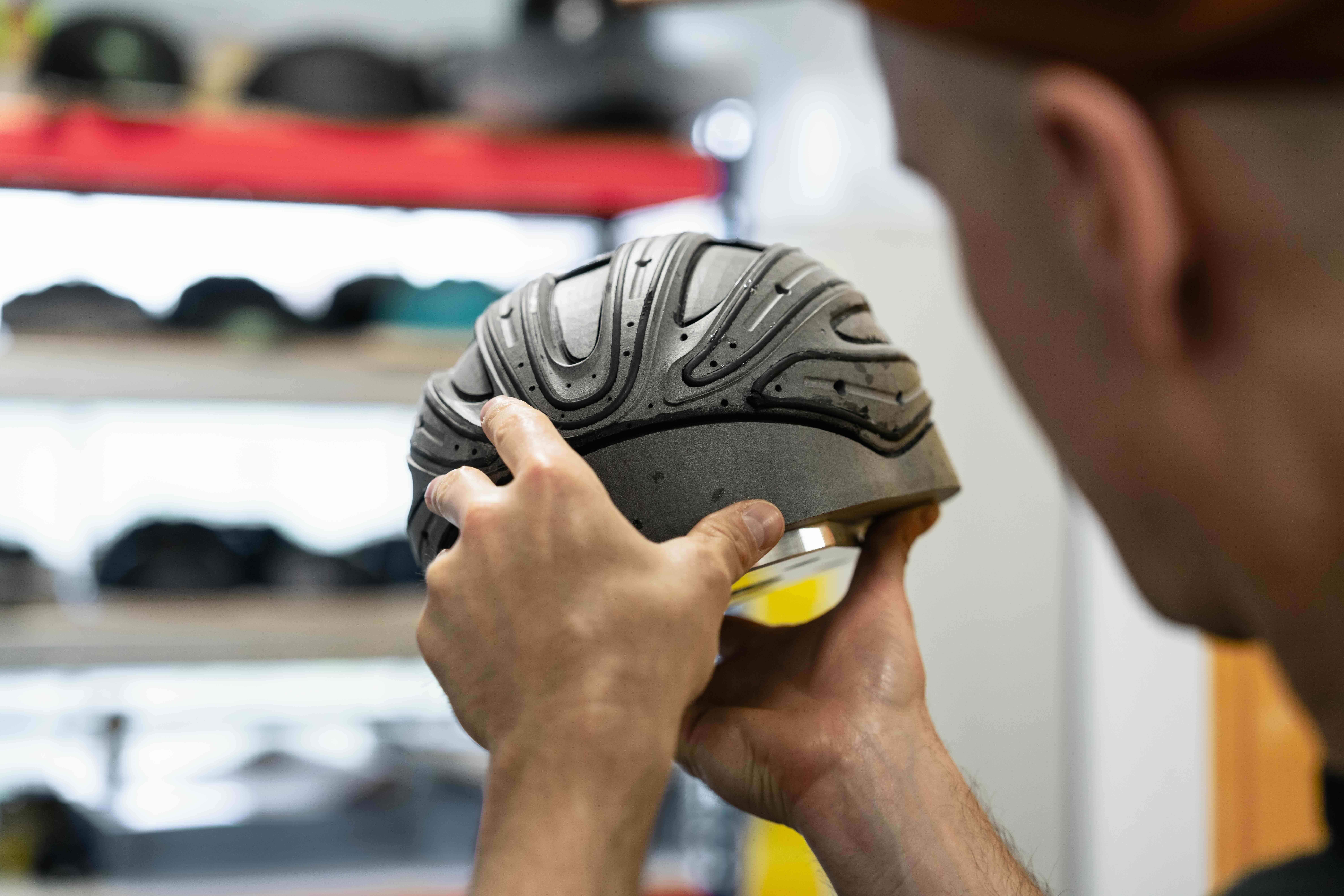
In the European standards, it is the cycling community that has came together to come up with a new method of helmet testing to push for more rotation mitigation. So using the cycling helmet as an example implementation was an important one for us to show how our rotation mitigation technology responds to upcoming changes in standards and new learnings from research by the injury biomechanics community.
Jamie: Also, Cameron, is it helpful just to give you a bit of background to our roles and, you know, what we have done in terms of experiences in engineering?
Cam: Yeah, that would be great, certainly. I’ve got a little bit just from the background on the company and also your LinkedIns, but yeah, absolutely happy to get some more detail there.
Jamie: Yeah, well, I guess I can go first. So my background is in Mechanical Engineering — I did my undergraduate for 3 years at UCL, in London and then postgrad in engineering science at Oxford University. As I left Oxford, I spun out HEXR to commercialize a 3D printed helmet.
So really from 2018, I’ve been more of a jack of all trades, master of none compared to being, as Maria is, deep in the trenches on R&D and science. But the team here are really focused on innovation. So while we’re still quite a small team around 15 people, most of us have deep experience around engineering or design.
Maria: My background is originally general engineering from Cambridge with a focus on control, so how all the individual materials and components come together to allow for the desired function of a system. Then I followed the academic route for quite a while, so I did my PhD and postdoc, exploring different aspects of this. In my PhD, I researched how materials interactions at the very small scale can affect the function of an engineering system often in an irreversible manner. Then in my postdoc, I moved towards biomechanics and investigated how biological systems work and adapt to match their needs.
So how do we tune a system within the constraints of biomechanics? Then I was interested in seeing how this knowledge can be applied in real life and into a product, which is where I diverged from the academic path and joined HEXR about 3 years ago.
Cam: Awesome. No, this is sparking many other questions that I think I would have for you personally outside of the Release Layer System work! A related question I have, which is more (I think) both materials and manufacturing focused is: I would assume that the majority of your panel components now are injection molded, especially as you look into incorporating your technology with 3rd party helmet vendors in the market. If you made the shift, I’m curious how you transitioned from 3D printing to injection molding, and if you saw any challenges in the process moving from prototyping the system more generally into actual mass manufacturing and scaling of the product.
Jamie: Absolutely. I was really excited about 3D printing because it provides complete freedom in design. There’s no limitation that you get with maybe injection molding and thermoforming where you need a tool set first, and often it’s quite expensive to begin making products. But with 3D printing, unfortunately, the materials are generally less consistent — at least this is going back five to seven years ago now. So while there was this freedom to design, there wasn’t necessarily the same sophistication around the quality and diversity of materials.
These deep experiences with 3D printing have given us unique DNA for how we think about design and product in the future. So we try to do things differently when it comes to injection molding and thermoforming: we try to take what we’ve learned with 3D printing (and Maria can go into this in more detail) to help us think about this open-ended question of how do we best protect people and prevent concussions?
Maria: I would say you might expect that a lot of our innovation would be focused mainly on the product, but actually we found that innovation was also needed on the process: how do we make something like RLS initially, then what do we need to change to make itin a repeatable way at scale. We had to think of all the assumptions and properties that might change when RLS is created at scale to make sure we are testing and breaking our own product appropriately to ensure that it stays robust as it can be as we transition out of prototyping. So it has been quite challenging, but I think it’s been a very interesting path.
Cam: Awesome! And I think related to that, I’m curious if you guys found any specific processes or tools that you found particularly useful in the transition from prototyping to scaled manufacturing?
Jamie: Well, going back to the early days, when we were first prototyping this ball bearing concept, we actually made the bearings via 3D printing, which was an unbelievably expensive process. And the quality wasn’t always that consistent, but it allowed us to again be incredibly quick and open-ended with how we thought about tackling the problem. And often, you know, you can go down in this route and things do stick and you learn about, you know, geometry and material properties far quicker by having lots of different ways of experimenting. So I would certainly say using 3D printing has been incredibly effective to help us quickly understand things.
Maria: One interesting thing is that if you come to our lab you might be surprised with the kind of equipment that we have because it’s not only mechanical testing equipment, as people would expect. It’s also equipment to test a materials’ viscosity, or the properties it has at different temperatures, similarly to a wet chemistry lab, which is not what people imagine when you say that we are doing innovation on a helmet.
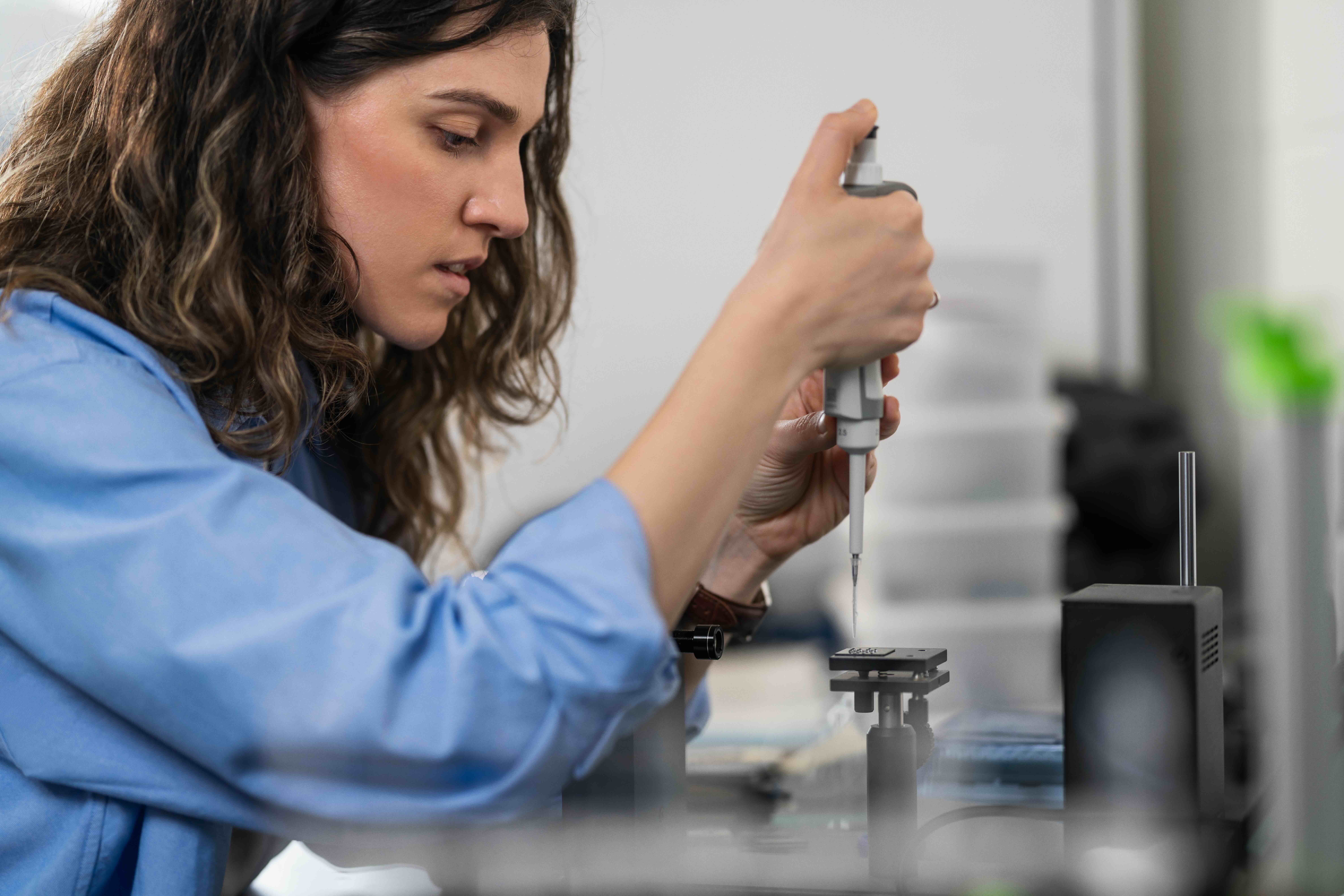
So I think those tools that allow us to fully characterize a system that has moving parts have been very helpful for us. And together with the fact that the people who work in the company have varied expertise, this means that every time we’ve asked why something happened in production, we could quickly either prototype a tool or buy a tool to actually replicate and test that effect and see whether it might matter for the product down the line.
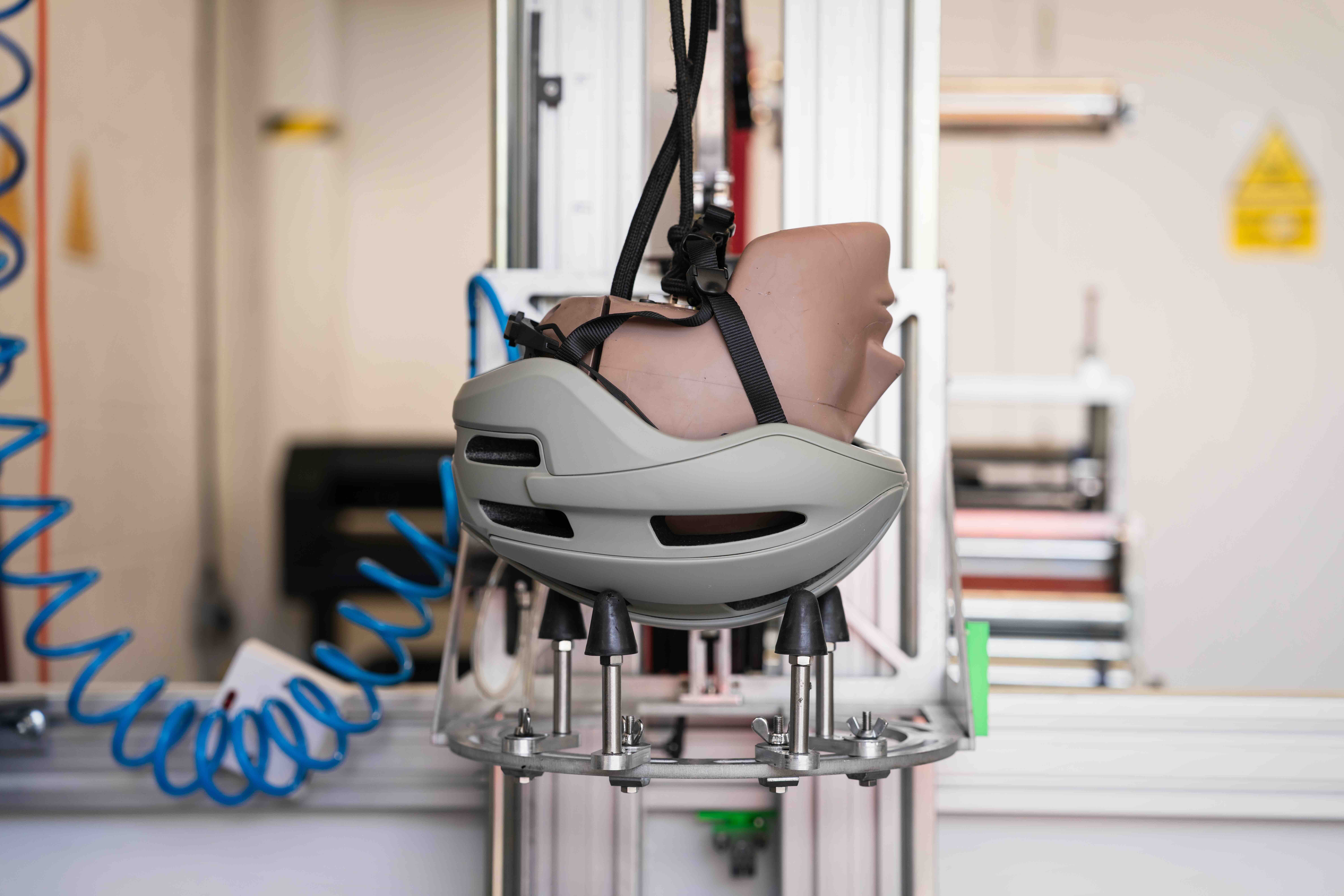
Another thing that I find has been very useful is that we have a state-of-the-art helmet testing facility in house, an early investment from the company. That has meant that we can not only come up with interesting new developments, but we were able to quickly answer the question: doesour idea actually make a difference? And that has massively helped in that feedback loop, right? We’ve got all the information straight away: are the components what we want them to be, do they match their predicted properties and does the final product work?
Cam: Awesome. I guess to take a step back and look at the product as a whole, were there any other concepts aside from the ball bearing design that kind of got left on the cutting room floor, so to speak?
Jamie: Top secret.
Cam: Haha that’s totally fine.
Jamie: I mean, there’s certainly a lot of interesting things. Whether or not they fully work, you know, it’s sometimes hard to know. But I think innovation can feel like a jigsaw puzzle, there are all of these different variables and interdependencies. So, you know, we would obviously rush to try and get a solution to market and find something that works, but often when you’re pioneering, there’s a whole sea of other interesting ideas. And we’re still trying to just catch up, to be honest, because there’s a lot of commercial interest for the technology right now.
But certainly, I would say that the future is bright in terms of what we can do to bring more safety to more people.
Maria: And something that has been very important for us is figuring out how to capture those ideas. Because we’re moving fast, we’re testing a series of concepts and we’re moving forward with specific options, we’ve had to go back and forth as we’ve gained many insights from the different ideas that we’ve ideated and tested. So early on, we realized it’s really important that we capture all our ideas so that they can also come back and complete that jigsaw puzzle that Jamie was describing.
Cam: Awesome! Yeah, I think a related question in terms of scaling the company and looking to commercialize at the same time is: how did you both think about structuring your technical teams and then also the company as a whole while you were growing from one to three to now fifteen people and simultaneously wanting to keep development velocity and also look at beginning to sell the product and engage customers.
Jamie: So, really good question. And I would say we’re actually quite lucky because the business model that we’re following is an ingredient business model. A big part of our value is to constantly create the best technical solutions for our brand partners. Then , our brand partners are largely responsible for marketing and selling the product with our technology to consumers. So that means we are able to have a disproportionally heavy R&D capability, and that’s valuable for the industry, and it’s valuable commercially for us as well.
In many other product companies, you might have an R&D team, but most likely there is a much larger sales and marketing team. And what we’re finding is that there’s a lot of organic demand for our technology, which is allowing us to still be very focused on just developing best in class product solutions.
I guess what we’ve done very well over the last 5 years is build out our capabilities specifically for developing solutions. It’s production (which in itself is very innovative). As Maria’s alluded to with testing facilities, capabilities surrounding how we record data, and there’s product development, which has a slightly different nuance to R&D. There’s all these different facets, but they all come together to create a great solution for our brand partners, and we anticipate that these solutions will only become cheaper and even more effective in the near future.
Cam: Awesome. And then maybe a similar line, in terms of growing the company from here, do you think about growing the team based on achieving milestones? Especially as you go to partner with more and more companies to actually sell your product, are you looking for increased demand signals to grow the team or are you more proactively looking to research and develop in different areas to kind of drive more of a supply sided growth for the company?
Jamie: Yeah, I would say strongly we’re trying to grow the team, because we know that there is going to be more and more interest for the technology. So at the moment, we believe there’s good applications for the technology in sports, cycling, equestrian, snow, and there’s also motorcycling (another big market). And then we’re pretty hopeful about industrial applications too.
Yes we are scaling the team, and we’re trying to get ahead of the curve. It’s always quite difficult to know exactly what that curve looks like because there’s also just day-to-day things to deal with in terms of quality, production in Asia, and so-on. So how we juggle our resources is always quite challenging— it’s a constantly moving target. I think the next three to six months are going to be tough just to deal with what’s right in front of us, but I’m hopeful over the course of 2026 we’ll have more and more facilities and team members to continue to evolve what we’ve built.
And even just head protection is one application! Who knows where this type of concept could go in the future. And that’s not just deflecting type solutions, it could be things that are completely out of the box, and things that we’re already interested in.
Cam: Fantastic. Well yeah, I think another question as more deep dive on the actual development side, were there any specific technical challenges that you guys were surprised about the difficulty? So, could be something extremely small in terms like material selection that was extremely difficult or a design aspect that was particularly challenging.
Maria: Well, whenever you’re putting together a series of components, it’s always a challenge. You characterize each of the components separately, and you know what you expect. You often think “okay, the system is the sum of its parts,” and then you put it together and it does something completely different in the beginning. So we constantly had to move between a system-level and a component-level approach, which was also then how the team was built and the expertise had to be varied to bring it all together.
Then, the fact that the technology is on the outside of the helmet meant that, in order to be proactive about questions that we thought we would get we had to develop a whole new set of testing protocols that we didn’t have any references for. You know, what does it mean for a helmet to be durable? People are thinking of damage due to the accidents that they are seeing, but what about regular wear and tear issues? It was very interesting to try and relate the work back to real life, and test the helmet across a host of very extreme conditions to answer potential questions.
But that’s kind of what I would say: we always try to also shift our position from somebody who’s developing a product to somebody who’s using a product. Saying “what would make me not buy this?” Then we started adding in the aesthetic aspects of it, the manufacturing aspects of it, all of that.
Jamie: Yeah, and when we first started, we actually tried to manufacture everything in one hit to reduce costs but it became very complex and introduced new technical challenges.
An important trait during the journey of innovation is how one has to constantly change their perspective. If you think “this is the way you should do it,” 9 times out of 10, it’s going to be wrong. You need to constantly remind yourself to open your eyes and mind to new ways of approaching the same problem. So it could be, for example: okay, let’s find one adhesive that solves it all, and then you open your mind and say, oh, we can actually use more than one adhesive to try to tackle all these various problems like durability or performance simultaneously. And later, “oh, actually, maybe we don’t have to look at adhesives at all! Let’s look at something entirely different, like a mechanical solution.” So it’s constantly about being flexible and open-minded to see the same problem, but from different perspectives.
Cam: Yeah, this is, again, making me think of probably 25 additional questions that I could ask! Obviously, I think more component level innovations, like the Release Layer System, require a lot of strategic IP (intellectual property) around them, and also probably for you guys, a rapid implementation of that IP, since you’re also looking to grow the company really quickly. So I’m curious how much effort went into your strategizing for IP before you actually went to implement it? And then, also any big takeaways from that process: was it more challenging than you expected? Less challenging? More or less of a time suck?
Jamie: Yeah, I can definitely answer this one.
It’s been a five-year IP strategy play. So luckily, some of our core patents have now been granted internationally, which is super important if you’re licensing a technology like we’re doing. The timeline on those — they can easily take three to six years, or even beyond that, so it was really gratifying to see that this year those core patents were granted.
Then obviously, the helmet industry has been going for a long time, so there’s a huge amount of IP and patents that are already in this space. So we’ve had to just be very mindful of navigating a course with the technology that allows us to have a clear freedom to operate, and that’s even more important when you think about how valuable the space is and how big some of the players are who are already operating in the space.
Maria: If I can add something, I think it’s quite interesting how you think about IP from an R&D perspective. When I joined, Jamie said something that stuck with me, which was, “whenever you’re struggling to solve a problem without an obvious solution, and you come up with a way of solving it, just note it down because that’s probably newand it is something that may be worth some drafting of IP”. Early on we found that we were just working to finalisedthe product, but you can’t do the work now and think of the IP later. So now all of us, as we’re problem solving, we’re also auditing what that means for our patents and our ideas and where they could grow. And that continuous process is something that’s really important.
Jamie: Yeah, it’s definitely fundamental, actually, with business models to be generating IP. And it’s an incredible valuable thing if you’ve got a really powerful patent because it’s essentially 20 years of exclusivity.
Cam: Awesome. Well, I think I just have 2 questions left at this stage. First, I’m just curious as you guys went through (probably) many late nights of sprinting to get demos done for potential customers or investors if there are any stories heroics that stood out to you in the multi-year process of getting this product to market that you wanted to highlight!
Jamie: Definitely one that comes to mind!
Maria: I have a few too! Go ahead.
Jamie: Well going back a few years now we developed what we thought was a good solution using a newly developed connector. And then we found that the connector would basically break at extremely high and low temperatures, and the whole thing could have become a critical issue with certifications.
At the time, we were also fundraising so it felt like a real pinch moment for the business as a whole. We sat down as a team and talked about it and we made an action plan to solve the problem. We got everybody involved on the problem. And there was this incredible drive and grit to figure out how to solve it.
Now 2 years later, we’re in a position where we’ve got a product that is working, and yeah, it’s not always certain how things will go, but I was really impressed and proud of the team.
Maria: Let me give you some more insight on the process of solving that problem as this was one of my moments too!
Me and a colleague were in a walk-in food freezer, in -10 degrees all geared up trying to do some low-temperature testing and we had conflicting feelings. We were very cold, so we wanted the connector to fail so that we could get out as soon as possible. But we also had worked so hard to make it work, so at the same time we wanted to be in there as long as possible because that would mean it’s working. It ended up working so we had to take turns to warm ourselves up and doing that testing. So there’s a lot of funny stories from those moments.
Jamie: He’s not still in the freezer is he?
Maria: Haha no, no.
Cam: That’s incredible. Yeah, I think last question on my end is: as you think about the company with both the external-facing side, but also the internal R&D/management side, what is next for you and what gets you most excited about the next 6 to 12 months?
Maria: For me, one of the most fun things was that for a while I would tell people what I do, but they didn’t really understand or believe it. And this year not only did we launch a product, but we also did a lot of testing externally for people to understand what RLS is and how it performs without us being connected to the testing. We then put together an academic publication where we addressed some of the gaps in knowledge from the academic community and some of the changes that are coming from the standardsto tie in together with the consumer and commercial side of things.
Now, we’re also communicating with all these different types of stakeholders and we’re connecting all these puzzle pieces of the real life accident scenarios that are happening and how our technology can help with that. How do they link to brain injury? What do we know now, and how can we help with that? And also compare ourselves to products that people might know — different commercial brands in those different fields.
And in this whole process, we also have to keep questioning ourselves: how do we best test something? Because as I told you earlier, cycling was a very good first step, but now to prove ourselves in all these other different fields, we also have to understand what is the right method. So, yeah, for me, it’s answering those gaps of knowledge and communicating with that wide range of stakeholders.
Jamie: Building on that, there’s a lot of things I’m excited about. If I had to choose two, firstly launching in different verticals, particularly, in new professional sports. It’s going to be huge for us, the visibility and the technology just looks great, the partnerships are very strong.
Then the other one is defining the gold standard for helmet safety. From publicly available data, the average risk of concussion of a certified bicycle helmet without anti-rotational technology is about 60%. So if you fall of your bicycle and hit the ground headfirst wearing a helmet without any advanced technology, you’re more than likely to have a concussion, and that’s at about 22-ish kilometers per hour now?
Maria: 23, yes.
Jamie: So not even that fast… For decades the industry has tried to persuade consumers to wear helmets and inadvertently communicating that all helmets which pass standard are safe. I assume for most people, if you ask, “are you safe wearing helmets?” They’ll say “oh, yeah, of course I’m safe because it passes a standard.” The reality is that current standards cannot guarantee safety and no helmet has equal safety.
What we’re doing is reducing that risk of concussion down to 15%. It is a major, major improvement, and I’m really looking forward to making that as clear as possible in the market to hopefully redefine what standards look like and what safety looks like. And I think if we can do that really well and effectively, hopefully we’ll make a big difference to the outcome of a lot of these injuries that are still happening.
Cam: Well, apparently I lied because I actually also have a follow-up question for Maria, well for both of you, in terms of expanding into different verticals here, while kind of also linking back to testing your product inside of a walk-in freezer. It seems like a lot of other verticals are going to have different environmental considerations: obviously different operating speeds and impact forces, and different operating environments that could be dustier, colder, hotter, etc. How do you think about upgrading your overall testing both in the lab and in the field to adapt your technology into these different environments?
Maria: Yeah, very interesting question, that’s definitely something we’re looking to do! Well, if you’ve seen the helmets being tested at the moment, you know that they include just a head form, which is a molded head, added into a helmet and dropped from height. In the past, it used to be on a flat surface, which is what the linear testing that we’re talking about is, and now testing is also done on an angled surface, to test the linear and rotational response of the system upon impact.. And that’s all well and good, and that allows us to look at rotation and concussion risk, but obviously, a real person is not just a head.
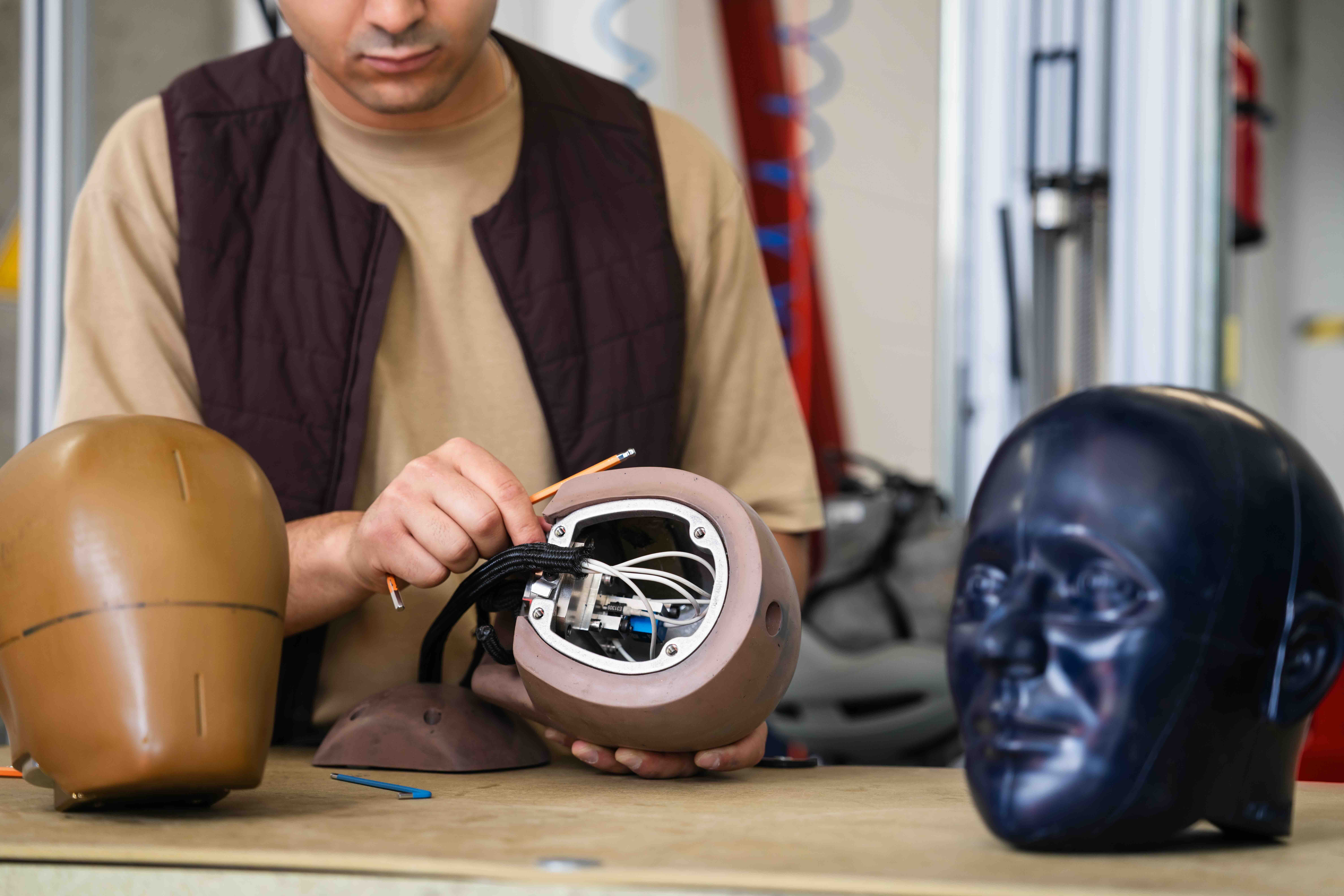
So, as an example, we are making steps towards looking into the effect of the neck in the whole process. That’s where engaging with the academic community that discusses spine injury biomechanics — and how the head and the and the neck come together for that testing — is very useful, both from a modeling perspective and an experimental perspective to understand the limits of each of these approaches. Then further on, even if you were to test with the neck, the current setups require the lower part of the neck to be stable, but again, that’s not how a person falls — so how do you add a body into such a setup? How would you test with that?
So we’re constantly thinking about upgrading our testing setup so that we can test in more representative conditions. We have active partnerships with academics in each one of those fields, but also on the modeling side, so that we can validate the results that we’re getting and assess what they mean.
And depending on the vertical, that testing could change. So, as one example, for a construction helmet, one important thing is that the majority of non-fatal accidents happen from objects that just fall on people’s heads instead of the head hitting a surface. So that is a completely different testing setup that we had to come up with. Or when considering snow helmets, you can imagine that the surface that people hit their heads on is completely different to cycling. So maybe developing an in situ drop tower that is on a slope would be the challenge. I think a very important part of developing those new verticals is questioning the test setups themselves and having that expertise in-house.
Jamie: So what Maria is really saying is she needs to go to a ski slope somewhere.
Maria: I would love to, if we need that person.
Cam: Chamonix might be the perfect place for some testing! Well, this has been extremely interesting. Again, thank you guys both very much for taking the time here!
Jamie: Awesome. Yeah you know, obviously we’re super excited, but we think there’s a big story to tell still, not only in how RLS is performing, but also just the current standard of helmet safety — it’s dangerously low and there are big strides to make!